You are the big bang, the original force of the universe, coming on as whoever you are– Alan Watts
We’ve gone on a tour of the universe, from the solar system to the deepest reaches of space. But have you ever wondered where our fantastic, colorful, intricate universe came from?
Edwin Hubble, a prominent astronomer, discovered that certain galaxies seem to cede away from us? How? He noticed that galaxies further away from us appear red? This color change due to levitating distance is called the redshift.

The image above shows the visible light spectrum. There are seven colors here. Red, orange, yellow, green, blue, indigo and violet. The color red has the lowest wavelength (a wavelength is a measure of the length between two peaks or troughs of a wave) at 700 nanometers (nm) while violet has the shortest wavelength at 400 nm. Red has a lower frequency compared to violet.
Now that we have introduced the visible light spectrum, we can now explain the redshift. Let’s say that there is a galaxy that is at a distance from us. At that time, we see it having a blue color. After 10 years, when we observe the same galaxy, it becomes redder. This is because light from the galaxy takes a longer time to reach us. The light waves eventually get longer in wavelength, and hence the red color. This is an example of the Doppler effect. It’s like listening to a siren from a firetruck. As it gets closer, the sound gets louder and vice versa. Light behaves like a wave (and so does sound), a longer propagation distance means the waves are more spread-out.

What does this mean for the universe? All the galaxies are receding from us. If you were to do the same observation on another planet, you would witness the same phenomenon.
So what can we conclude about this redshift? The universe is expanding (expanding at an accelerating rate. We will get through that in the future).
If we perceive time reversing, cosmic expansion becomes cosmic deflation. The galaxies will get closer and closer, they will blueshift (the opposite of redshift).
Eventually, we will reach a point where all the stuff in the universe is concentrated at a single point in space. There will be no galaxies, but small particles. All at a singularity.
You are now witnessing the birth of the universe.
To My Dear Universe, Welcome to Existence…
In the beginning, there was nothing…
You’ve probably heard this saying a lot in movies. But saying “before the universe” would not make any sense. Why? Because there was literally nothing in the beginning. I know, you must doubt this. There has to be something that triggered the universe to emerge… That would require a theory (more will be discussed in the future). Even I can’t make sense of this…
…
…
…
…

At a time almost to an instant, the universe emerged from its shell, releasing gargantuan quantities of energy. Simultaneously, space and time were created alongside a grand force. This is what’s known as the Big Bang. This isn’t really an explosion though. It’s rather an expansion, a rapid one.
We are not absolutely certain on whether the Big Bang authentically happened. It’s all based on Hubble’s Law where the universe is expanding.
Post-Genesis Period
After the Big Bang, the universe entered its Dark Ages. The universe was still expanding. This period marks the formation of matter.
Albert Einstein discovered a relationship between energy and matter: they’re the same thing. When energy condenses, it forms matter. This is all explained through a mathematical formula. E=mc^2. E is the energy, m is the mass and c is the speed of light. 1kg of energy contains at most 90000000000 megajoules of energy!
As energy condenses, they form particles of matter. 6 types of quarks (up, down, top, bottom, strange and charm.), 6 types of leptons (electrons, muons, taus, and their neutrino versions.) These particles are called fermions. In addition, another type of particles called the bosons (force carriers) include the photon, gluon, W boson, Z boson, and the Higgs boson.
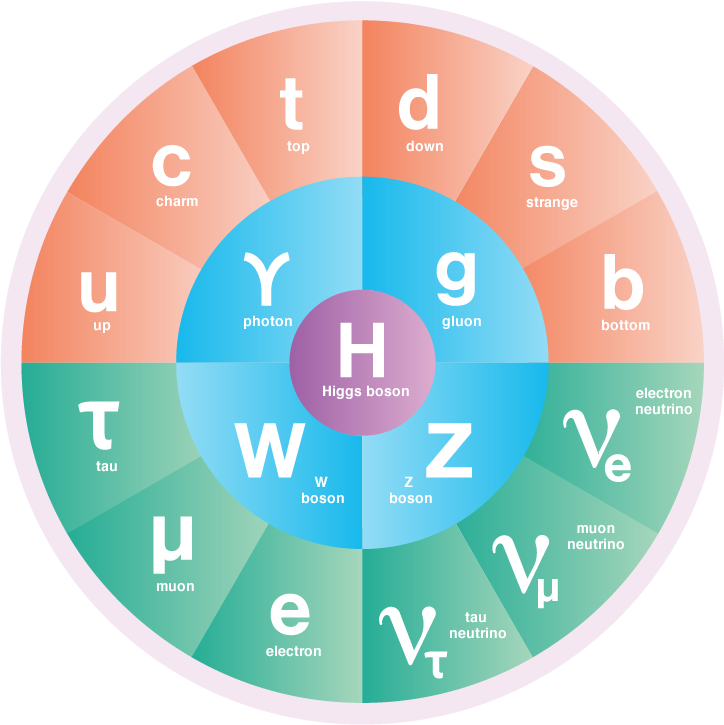
For every particle that was formed, an opposite version of them was created. If the net energy of the universe was 0, there had to be an equal proportion of charged particles, in which all elementary particles have (the particles I’ve mentioned). For instance, a quark has an anti-quark with a negative charge, an electron has a positron with a positive charge. When two opposite charges collide, they annihilate each other releasing tremendous amounts of energy. So, matter wouldn’t exist because there are equal amounts of matter and antimatter. But to our surprise, matter survived. This is still an unknown conundrum in physics that is yet to be solved.
After annihilation, there were some particles of matter left. And the formation of atoms began.
Atoms: The Basic Unit of Matter
It all starts with the quarks. Up quarks have a positive charge (+2/3) while down quarks have a negative charge (-1/3). The combination of two up-quarks and one down-quark results in a new particle with an overall +1 charge. This hadron (composite particles made of 3 smaller particles) is called a proton. If we had 2 down-quarks and 1 up-quark, we would have a hadron with no charge. This is the neutron. We can have a hadron with 3 down quarks and 3 up quarks, but they won’t last long. These quarks are held together by a boson called a gluon. This is the strong nuclear force that keeps the quarks together.
Leptons are matter particles of negative charges. The electron is the smallest of the leptons.
Recall that a proton has a positive charge. If the proton and the electron are attracted, they would exchange photons (this is the electromagnetic force). The electron would not fall to the proton due to quantum effects. On an atomic scale, the laws of physics behave very differently.
The electron is now attracted to the proton as their charges cancel each other out. And at last, we have an atom. Hydrogen.

Concerning the other bosons, the W and Z particles drive nuclear decay and the Higgs boson gives the particles their masses through the Higgs field. In the case of gravity, we found nothing about it. But we are still on the lookout for the particle carrying it.
Now that we have atoms, what’s next?
To be continued…

 The Mysterious Universe